Drama

D. Sit
Teacher of Drama

G. Brougham
Deputy Headteacher
Intent
At Royal Greenwich Trust School, the Drama curriculum aims to develop confident, expressive and critically aware young people who can communicate ideas, emotions and perspectives through performance. We want every student to leave RGTS with the ability to collaborate creatively, think imaginatively and perform with confidence, whilst understanding the cultural, historical and social significance of theatre in the wider world. Through Drama, students learn to explore human experience, question perspectives and develop empathy, resilience and self-expression.
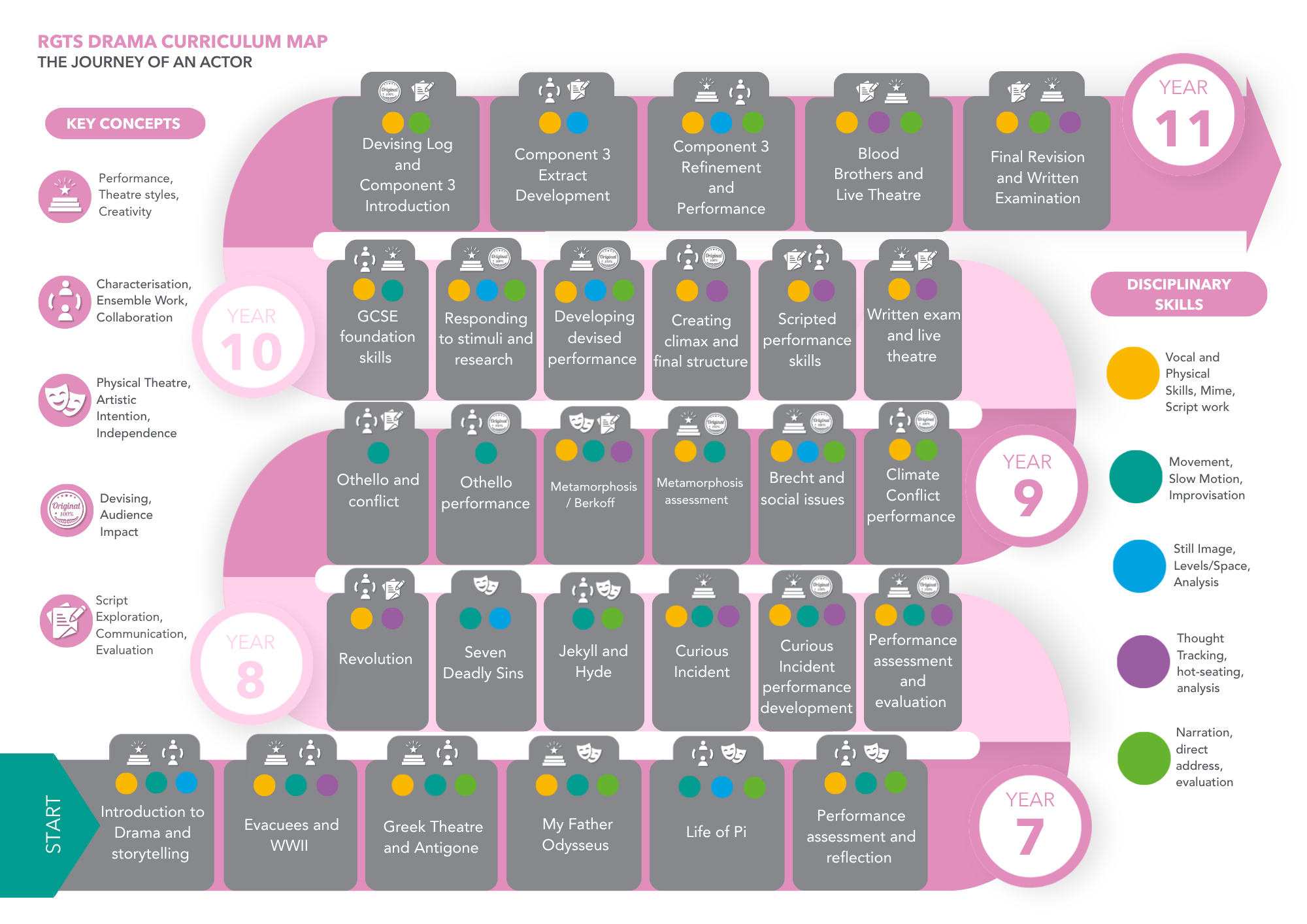
Our curriculum is carefully sequenced and rooted in the consistent development of core dramatic disciplines including physical theatre, vocal performance, devising, ensemble work, script interpretation and performance analysis. Across KS3 and KS4, students revisit and deepen these concepts through a spiral curriculum, enabling them to build technical proficiency, creative confidence and independence over time. Students move from highly scaffolded exploration in Year 7 to increasingly sophisticated devised and scripted performance work in Years 8 and 9, before specialising through GCSE Drama in Years 10 and 11.
At KS3, the curriculum focuses on building strong foundations in performance, collaboration and creative communication. Students are introduced to key Drama conventions and techniques including still image, slow motion, narration, mime, physical theatre, chorus work, puppetry and script work through carefully selected texts and stimuli such as The Evacuees, Antigone, My Father, Odysseus and Life of Pi. Students explore themes such as conflict, identity, morality, power, migration, survival and social responsibility, enabling them to understand how theatre reflects both historical and contemporary society. Regular opportunities for rehearsal, reflection, self-assessment and performance ensure students develop resilience, discipline and confidence when working independently and collaboratively.
The curriculum is deliberately designed to expose students to a wide range of theatrical styles, genres and practitioners. Students explore Greek Theatre, Physical Theatre, Verbatim Theatre, Epic Theatre and non-naturalistic performance, alongside contemporary practitioners such as Frantic Assembly and Berkoff. Through this broad exposure, students develop cultural capital and understand how theatre can challenge audiences, communicate political ideas and explore complex human experiences. Cross-curricular links with English, History and PSHE further strengthen students’ understanding of narrative, context and society.
At KS4, students apply and extend these foundations through the GCSE Drama course. Students develop greater independence through devising, scripted performance and theatre analysis. They explore texts such as Blood Brothers through both practical and written study, while refining their ability to interpret character, communicate meaning and evaluate performance choices. Students learn to analyse how staging, design, movement and vocal skills create impact for an audience, whilst developing the discipline, resilience and creativity required for successful live performance and written examination outcomes.
Assessment is integral to the Drama curriculum. Through practical performances, teacher observation, self-evaluation, written reflection and verbal feedback, students continuously refine their work and deepen their understanding of theatrical techniques. Retrieval practice and explicit vocabulary instruction ensure students can confidently use subject-specific terminology and articulate their creative intentions with precision. Disciplinary literacy is explicitly embedded through script analysis, evaluative writing, discussion and performance critique, strengthening students’ confidence in both written and spoken communication.
Beyond performance skills, the Drama curriculum plays a vital role in students’ personal development. Students learn to work collaboratively, listen actively, respond creatively and take risks within a supportive environment. Drama develops empathy by encouraging students to explore diverse perspectives, experiences and emotions through role play and storytelling. Opportunities for enrichment, rehearsal, performance and ensemble work further strengthen students’ confidence, leadership and communication skills.
Our curriculum is underpinned by the RGTS values of Responsibility, Grit, Teamwork and Success. Students are encouraged to take responsibility for their rehearsal process, persevere through creative challenge, collaborate effectively as ensembles and take pride in their performances and achievements.
A student of Drama at RGTS develops as a confident communicator, reflective performer and creative thinker. They leave with the ability to collaborate effectively, interpret critically, perform expressively and engage thoughtfully with the world around them. Our overarching intent is to ensure that all students not only achieve highly in Drama but also develop the confidence, empathy and communication skills that will support them far beyond the classroom.
Curriculum Map