Sociology

B. Geisler
Head of Department - Social Science
Vision
Sociology at Royal Greenwich Trust School is an engaging and thought-provoking subject that encourages students to question and better understand the social world around them. Through the study of key topics such as families, education, crime and inequality, students explore how society is structured and how different groups experience life in diverse ways.
The aim of the course is to develop curious, analytical and reflective learners who can think critically about contemporary social issues. Students are introduced to a range of sociological perspectives, enabling them to evaluate evidence, challenge assumptions and form their own informed viewpoints.
This inspires students to become socially aware and active individuals, equipped with the confidence to question inequality, appreciate diversity and contribute positively to their communities.
Intent
At Royal Greenwich Trust School, our GCSE Sociology curriculum is designed to inspire students to question, explore and understand the social world in which they live. We aim to cultivate a deep curiosity about how societies are structured, how they change over time, and how individuals and groups experience the world differently. Through a challenging and engaging curriculum, students develop the intellectual tools needed to make sense of contemporary social issues and to appreciate the diversity and complexity of modern life.
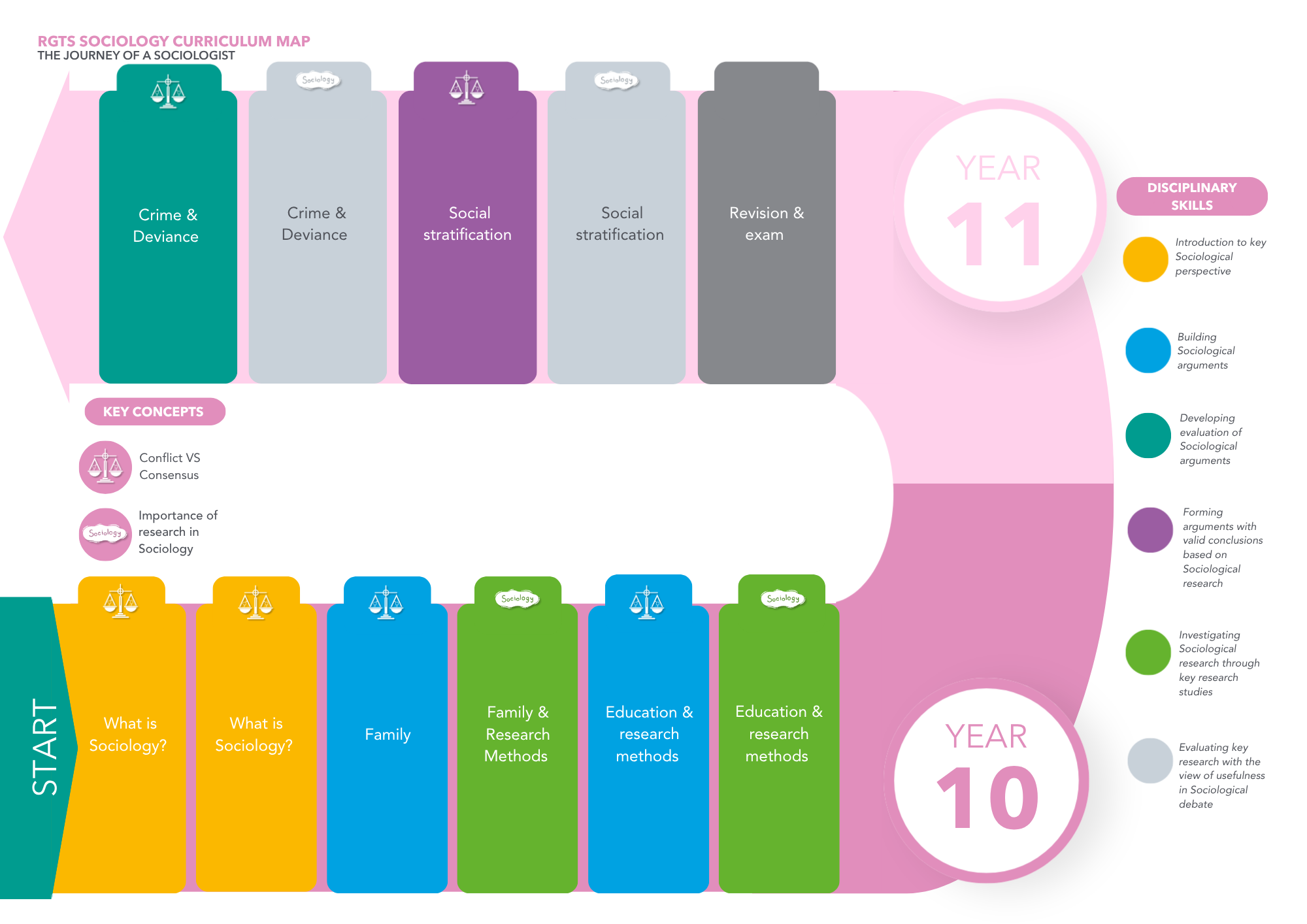
Across the course, students investigate key themes such as families, education, crime and deviance, and social stratification. Each topic is approached from multiple theoretical perspectives and encourages students to interrogate the relationship between individuals and social institutions. By studying the work of classical and contemporary sociologists, students learn how theories and evidence are used to develop explanations about society.
Throughout their GCSE studies, students will build their ability to think critically, analyse social patterns, and evaluate competing arguments. They will develop an understanding of higher-order concepts such as power, socialisation, identity and inequality, enabling them to formulate their own evidence-based judgements about the world around them. Our curriculum equips students with a rich knowledge base and a highly transferable skillset—communication, analysis, evaluation and cultural awareness—that will benefit them across subjects and future pathways.
Most importantly, we aim to empower RGTS students to recognise their role within society and to feel confident in challenging injustice and contributing positively to their communities.
Curriculum Map